






















Some demurrage and detention charges do not have to be paid, and the invoice itself shows it. Under 46 CFR 541.5, an invoice that leaves out any of the minimum information required by the Federal Maritime Commission “eliminates any obligation of the billed party to pay the applicable charge.” The FMC’s announcement of the rule adds the other half: an invoice that does comply creates an obligation to pay.
The Federal Maritime Commission rule covers invoices from ocean carriers, marine terminals and NVOCCs in FMC-regulated, US-linked shipping. Lay an invoice for demurrage and detention charges next to the container’s own dates (discharge, gate-out, empty return) and look for gaps in the carrier’s data and for a late invoice.
Missing data removes the duty to pay
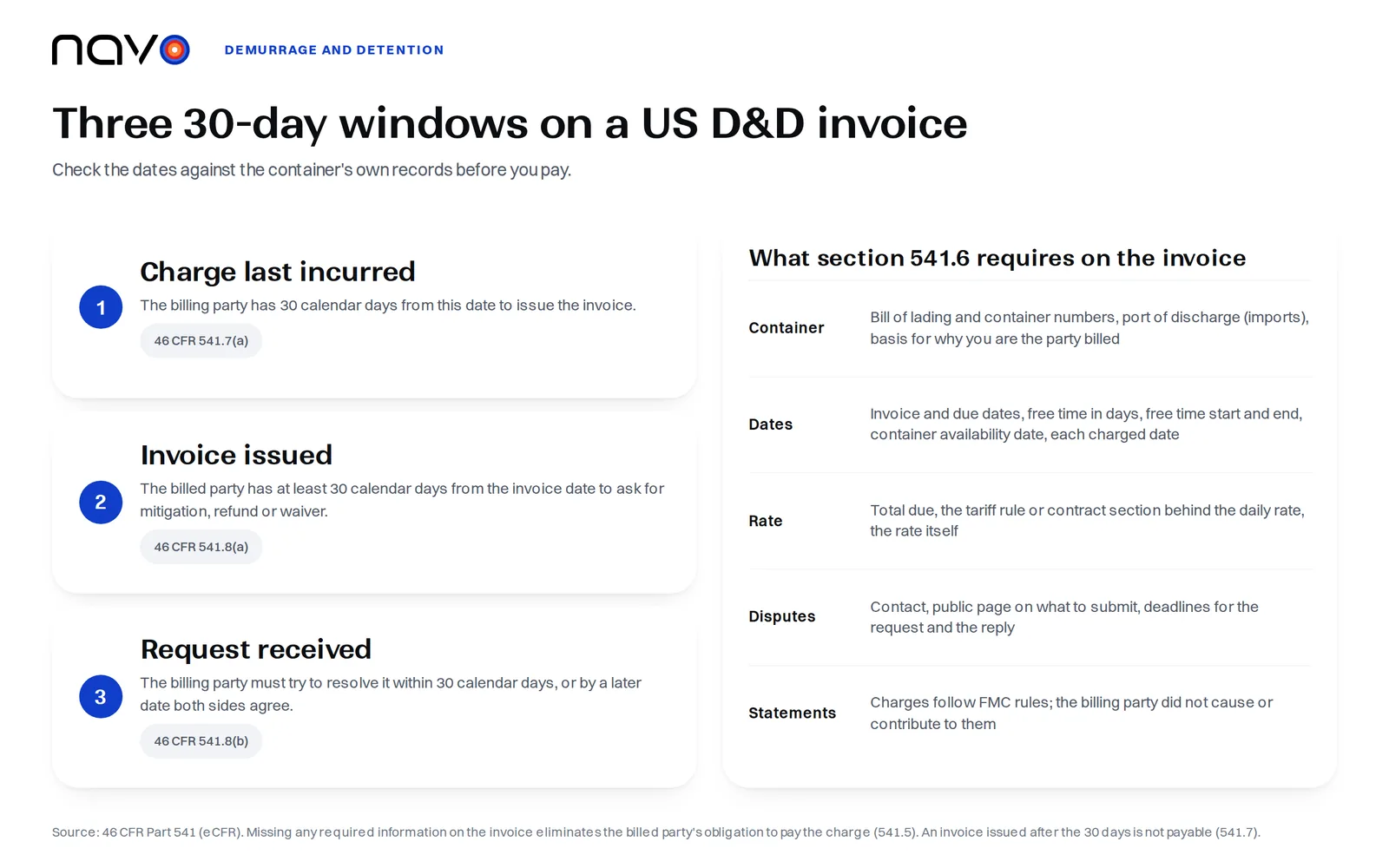
Section 541.6 sets out what an invoice must contain. To identify the container: the bill of lading number, the container number, the port of discharge on imports, and the basis for why the billed party is the proper party to charge. For timing: the invoice date and due date, the allowed free time in days, the start and end dates of free time, the container availability date on imports (the earliest return date on exports), and each date for which a charge was applied. For the amount: the total due, the tariff rule, service contract section or other arrangement the daily rate comes from, and the rate itself.
Disputes get their own block. The invoice must give a contact for questions and for requests for fee mitigation, refund or waiver, a web address, QR code or similar that leads to a public page describing what the billed party must submit for such a request, and the deadlines for asking and for the carrier’s reply. It must also state that the charges follow FMC rules, including 46 CFR 545.5, and that the billing party’s own performance did not cause or contribute to the charges.
The final rule was published on 26 February 2024. In September 2025 the D.C. Circuit set aside one section, 46 CFR 541.4, which had limited who may be invoiced; the FMC says the rest of Part 541 remains in effect, including the contents and 30-day requirements below. Most of the rule, including the invoice contents in section 541.6, took effect on 28 May 2024.
The availability date deserves a second look. Section 545.5 says the Commission may consider whether demurrage and free time are tied to the date cargo can be retrieved. If the invoice shows a later availability date than the one you were given, raise it in the dispute.
Thirty calendar days is the number to watch
The billing party must issue the invoice within 30 calendar days from the date on which the charge was last incurred. If it does not, the billed party is not required to pay (541.7). An NVOCC has 30 calendar days counted from the date of the invoice it received. A carrier that billed the wrong person can reissue to the right one, but only inside the same 30 days.
The billed party has a window too. Under section 541.8 the billing party must allow at least 30 calendar days from the invoice date to ask for mitigation, refund or waiver, and must try to resolve the request within 30 calendar days of receiving it, or by a later date both sides agree.
Carriers draw the clocks differently
On demurrage vs detention, Maersk’s explainer for buyers splits the two by location. Demurrage is the time a full container spends inside the terminal, from offloading to gate-out. Detention is the time outside the terminal, from pick-up until the empty comes back. UNCTAD gives the same split. The FMC’s 2015 study of selected US ports found that terminology and application of charges with similar names are distinct across carriers, which makes direct comparison difficult.
The tariffs show where the details part, and what sits inside the demurrage and detention charges differs by carrier. APL’s general terms keep storage costs, such as quay rent, and reefer services outside demurrage and detention unless the country tariff says otherwise. Maersk’s UK export page states that its demurrage includes storage tariffs, and that reefer demurrage includes plug-in electricity charges.
Counting rules vary as well. Unless an individual tariff says otherwise, APL counts each day or part of a day in full, starts the first chargeable day after the last day of free time, and quotes durations in calendar or working days. Maersk’s UK export tariff uses calendar days, with public holidays counted as ordinary days, charged per container, per day and per container type. APL says a cancelled booking has no free time. On UK exports, Maersk adds that shipper-owned containers pay demurrage and no detention. APL also defines a merged D&D period, which for imports runs in one block from vessel discharge to the return of the empty, and for exports from pick-up of the empty to loading on board.
Free time differs by port and carrier. For MSC, a separate walkthrough explains how to read free time port by port before the box arrives. The invoice must show the free time it applied and the tariff rule behind the rate, so the clock the carrier ran can be checked line by line.
Delays outside the merchant’s control
UNCTAD notes that late pick-up or return is often down to bad weather, labour strikes or terminal congestion that the merchant cannot control. Section 545.5 lists related factors the Commission may weigh. It may consider whether and how notice of cargo availability was given. Detention imposed when an empty container cannot be returned is likely to be found unreasonable absent extenuating circumstances. For government inspections, it may consider whether the charges still serve their purpose and whether extenuating circumstances exist. “May consider” is not an automatic waiver, so the request needs evidence.
Examination by Customs adds its own costs. Under 19 CFR 151.6, the importer bears the expense of preparing merchandise for Customs examination and of closing packages, except where the port director requires examination at the public stores.
A request for mitigation is easier to decide with gate-out and gate-in records, the date cargo became available, and the date of any hold. The invoice must point to a public page that describes what to submit, and that page is worth reading before the 30-day window closes.
Extra free time is arranged before arrival
In a 2023 explainer, Maersk says it shows free time with the price details at booking and that importers can buy extra detention days at the time of the import booking on Maersk Go. In its 2018 best-practice guide, summarised by UNCTAD, the FIATA working group suggests that commercial partners negotiate an agreement that extends free time by the length of any period when the terminal cannot release or receive a container. The FIATA guide is a set of voluntary best practices.
Log the gate-out and empty-return dates as they happen. The carrier’s 30 calendar days run from the day the charge was last incurred, and the 30-day request window runs from the invoice date.
Frequently asked questions
What if an NVOCC passes the carrier's invoice on to me?
A non-vessel-operating common carrier can be both a billed and a billing party for the same charge. Under 46 CFR 541.7(c) it can tell its own billing party that the charge has been disputed, and that party must then give the NVOCC an additional 30 calendar days to dispute it. The NVOCC's invoice to you is due within 30 calendar days of the date on the invoice it received.
Does the invoice rule cover charges between a carrier and a terminal?
No. Part 541 governs invoices issued by an ocean common carrier, marine terminal operator or NVOCC for demurrage or detention charges. Section 541.2(b) says it does not govern billing relationships among and between ocean common carriers and marine terminal operators.
What can I do if the carrier ignores a mitigation request?
Section 541.8(b) requires the billing party to attempt to resolve the request within 30 calendar days of receiving it, or at a later date both parties agree. The FMC says carriers and terminals that do not follow Part 541 risk being found in violation of the Shipping Act, and it points shippers to its Complaints and Assistance page for possible violations.