





















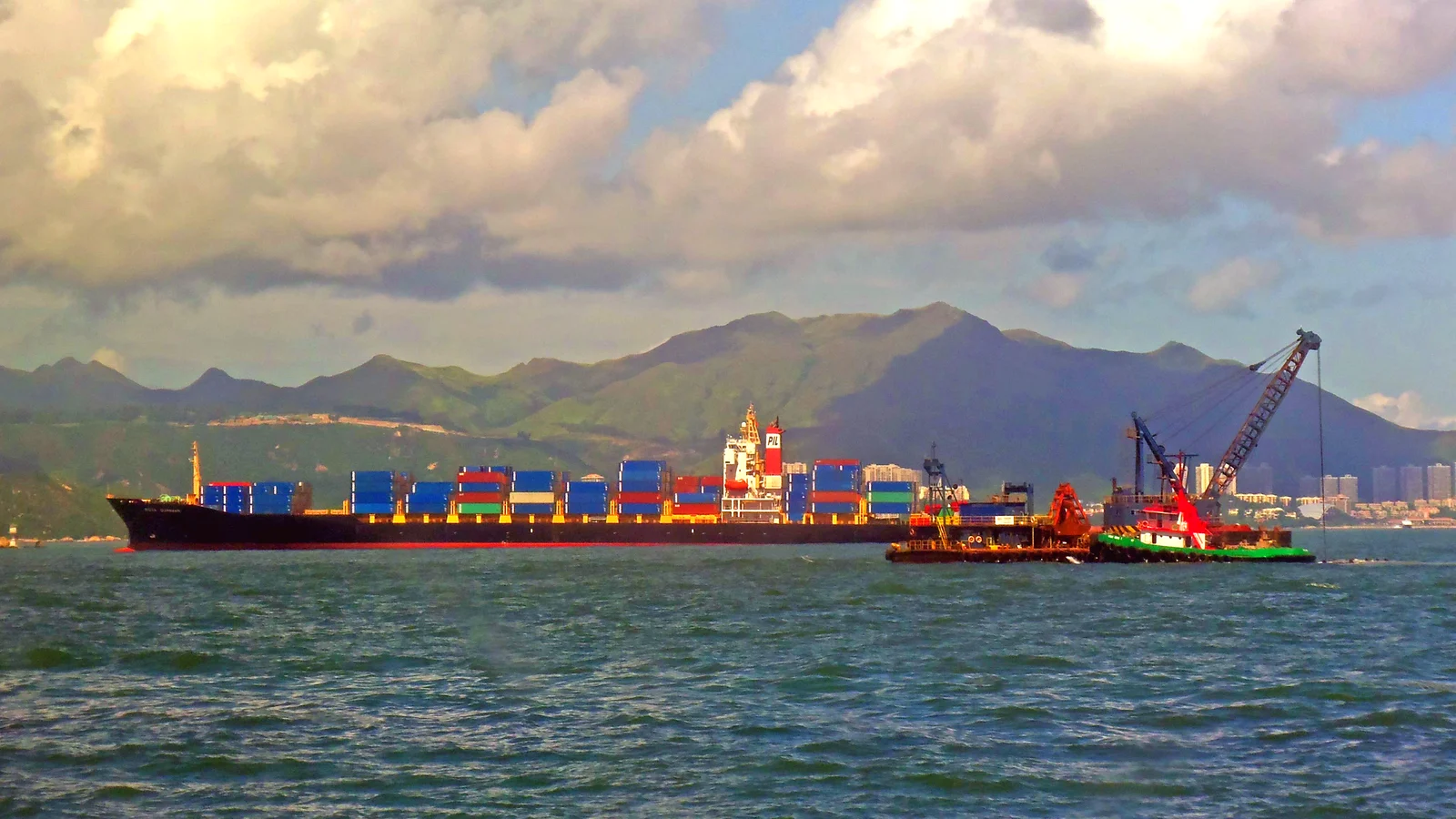
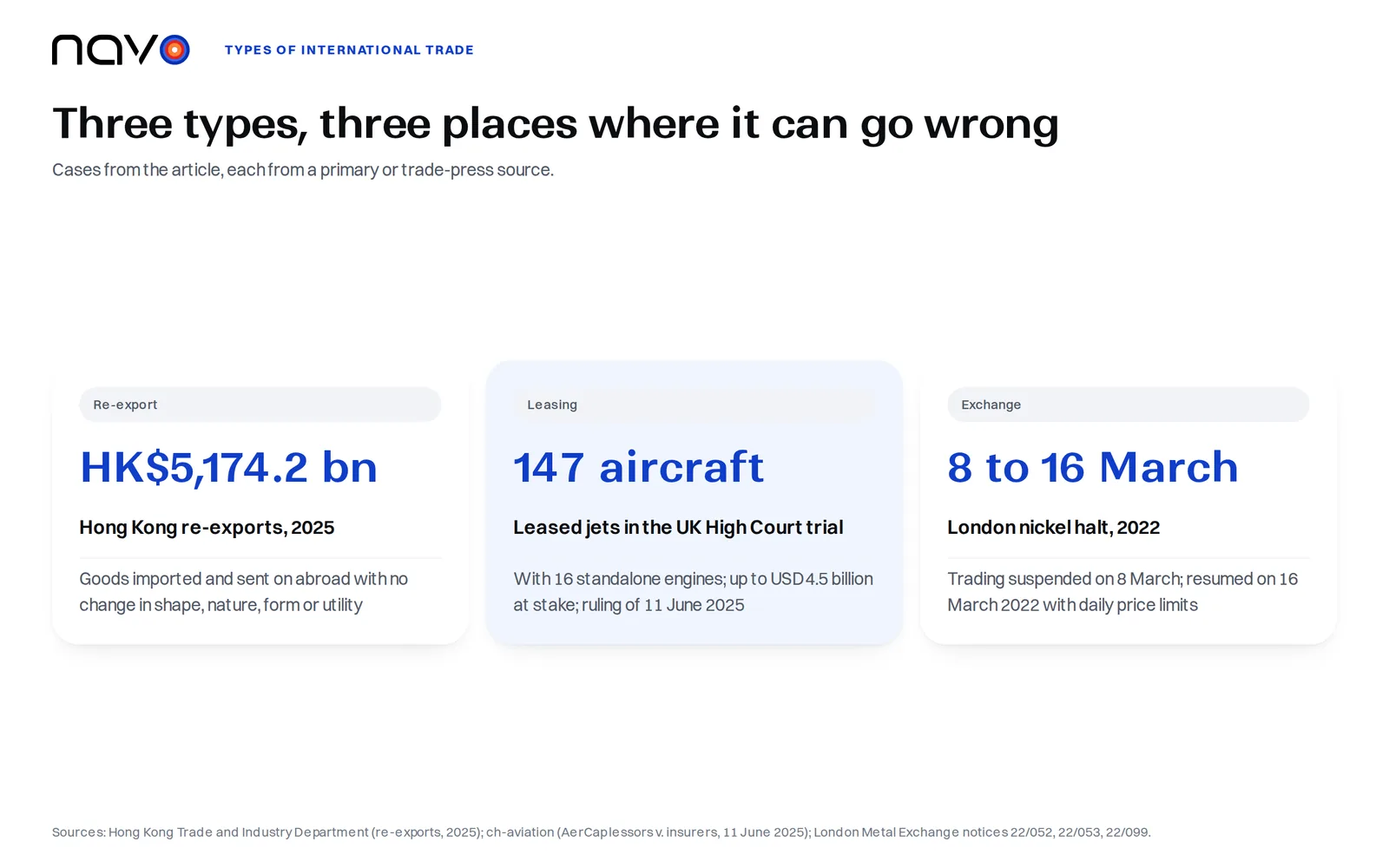
Hong Kong’s re-exports totalled HK$5,174.2 billion in 2025, according to Census and Statistics Department figures published by the Trade and Industry Department. Those goods were imported first and sent abroad again. Re-export is one of the types of international trade a shipper meets in practice, next to temporary admission, leasing, licensing, countertrade and exchange trading. Each has its own paperwork and its own weak point, and the cases below show where.
Re-exports are goods that leave in the same shape they arrived
A Hong Kong Monetary Authority bulletin defines re-exports as products first imported into Hong Kong and later re-exported with no change in the shape, nature, form or utility of the products. Domestic exports are the products made in Hong Kong for export. The split matters when you read a trade statistic, because an export total for a trading hub includes goods that someone else made. A shipment in that chain crosses two borders, and you can follow the container through both legs.
A carnet suits goods that travel and return
Goods sent abroad for a short time and brought home again are a separate case. The ATA Carnet, which trade.gov describes as an international customs document, allows temporary entry of goods duty-free and tax-free, whether shipped or hand-carried. It covers commercial samples, professional equipment and goods for trade shows and exhibitions. The same page says it is not recommended where some products taken abroad may be sold there. In the United States the issuing association is the U.S. Council for International Business, and the holder shows the carnet to CBP on leaving and on return.
Leasing separates the owner from the operator, and a war tested it
In a cross-border lease the lessor sits in one country and the equipment works in another. The 1988 UNIDROIT convention on international financial leasing was written for the case where the lessor and the lessee have their places of business in different States.
The largest recent test is the aircraft leased into Russia. According to ch-aviation, the lessors began sending grounding and relocation notices to Russian lessees on 28 February 2022. A Russian government resolution of 9 March 2022 effectively barred Russian airlines from returning the aircraft. On 11 June 2025 Justice Butcher ruled in the UK High Court that the loss fell under “war risks” policies. The trial combined claims for 147 aircraft, 16 standalone engines and one other piece of equipment, brought by AerCap, DAE Capital, Merx Aviation Finance, Falcon 2019-1 Aircraft 3 Limited and Genesis Leasing, with up to USD4.5 billion at stake. AerCap owned 116 of the aircraft and 15 of the engines.
The court treated the cover as contingent rather than possessed, because the lessors were not physically holding the aircraft. Reuters reported that AerCap could recover just over $1 billion from its war risks insurers, against roughly $2 billion it sought under a broader all-risks clause, and that on 31 March 2026 insurers including Chubb, Fidelis and Lloyd’s were granted permission to appeal. For a lessor with equipment abroad, the ruling turned on which policy applied and on who physically held the asset.
Licences and services cross borders without a container
WIPO describes a licence as permission to use your intellectual property, granted in exchange for something of value such as a lump sum or recurrent royalties, while you remain the owner. Patented technology and know-how can be licensed to another party this way, which makes licensing one of the types of international trade with no cargo at all.
Services follow a similar logic of crossing a border without cargo. The WTO’s GATS training module lists four modes of supply: cross-border, consumption abroad, commercial presence and movement of natural persons. Its own examples for the first mode include consultancy or market research reports and architectural drawings sent from abroad.
Countertrade replaces money with goods, and the terms are narrow
An UNCITRAL Secretariat outline of 1989 proposed fixed vocabulary for it. The outline defines barter as a two-way exchange of specified goods, where each supply replaces the payment for the other. In a buy-back the supplier of a production facility agrees to buy the resulting products. A counter-purchase differs because the goods supplied first are not used to make the goods sold in return. An offset usually involves high-value goods, and in an indirect offset a government agency requires the supplier to make counter-purchases in the buying country. The same document notes that in some countries countertrade is subject to governmental regulation.
An exchange can cancel trades after they are booked
Exchange trading runs under the exchange’s own rulebook, and the nickel episode of March 2022 shows what that allows. On 8 March 2022, after overnight rises in the three-month nickel price, the London Metal Exchange suspended nickel trading from 08:15 London time. A further notice cancelled all trades executed on or after 00:00 that day and deferred delivery on physically settled contracts due from 9 March. Trading resumed on 16 March 2022 with daily price limits and a new requirement for OTC nickel data, which, as the LME’s 4 April notice put it, it had not previously had. The same notice named sizeable OTC positions, and the exchange’s lack of direct visibility of them, as one factor behind the episode.
Frequently asked questions
How long does an ATA Carnet stay valid?
The trade.gov guide says carnets are in effect for up to one year, with a possible extension for another year. The same page says a carnet does not cover consumable or disposable items.
Does licensing intellectual property transfer ownership?
No. WIPO describes a licence as authorising someone else to use your IP while you keep ownership, in exchange for a lump sum, royalties or both. A transfer of all exclusive rights to another person or entity is an assignment, which is a different transaction. Licences can be sole, exclusive or non-exclusive.
When does the UNIDROIT convention on international financial leasing apply?
Article 3 of the 1988 Ottawa convention applies when the lessor and the lessee have their places of business in different States and either those States and the supplier's State are Contracting States, or both the supply agreement and the leasing agreement are governed by the law of a Contracting State.